Jiu-Jitsu
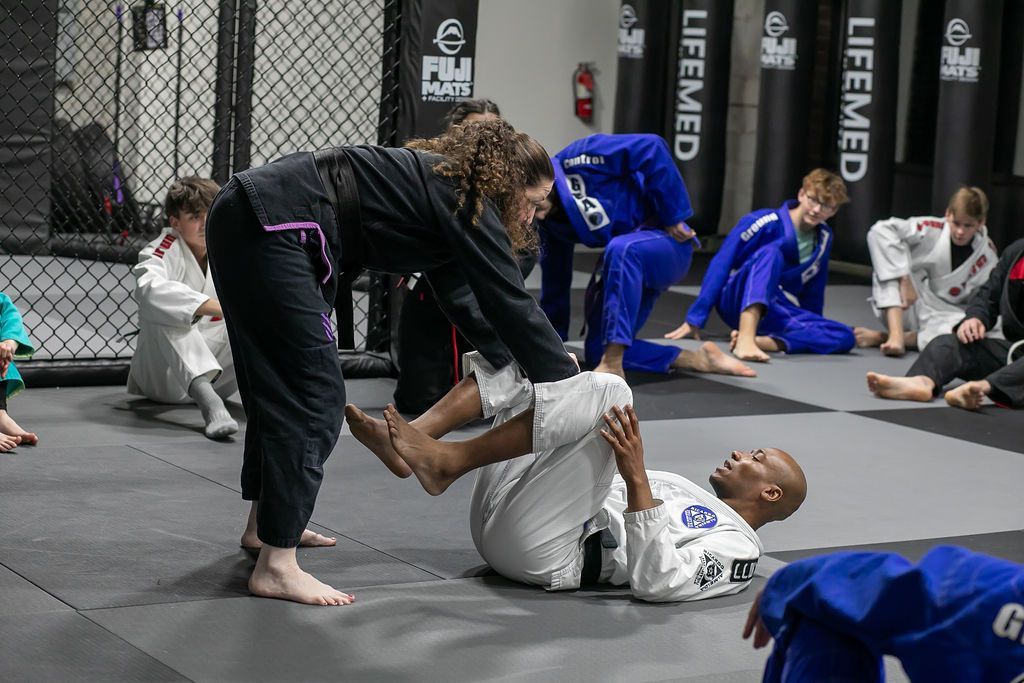
Advanced Brazilian Jiu-Jitsu Training in Sparks Glencoe for practitioners sharpening timing, transitions, and submission strategies alongside higher-ranked grapplers
Technical Refinement Through Experienced Training Partners
Experienced practitioners see smaller technical improvements that take longer to develop than the rapid skill jumps that happen during the first year of training. Ground Control Hunt Valley integrates advanced students into the same classes as beginners, which means you train with partners at every skill level rather than being isolated in a separate advanced session. This approach forces you to adjust your game constantly, defending against unpredictable beginners while executing high-level techniques against experienced training partners who recognize and counter standard attacks.
Advanced training focuses on detailed instruction that reveals timing windows, grip adjustments, and positional nuances invisible to newer students. You learn to recognize when an opponent's weight shifts by a few inches, signaling the moment to execute a sweep or escape. Transitions between positions become smoother because you've drilled the same sequences hundreds of times, and your body moves through them without hesitation.
Arrange a training session to experience how mixed-level classes expose you to diverse grappling styles and skill sets.
Why Mixed-Level Training Accelerates Development
Rolling with beginners forces you to execute techniques with precision rather than relying on superior athleticism or experience to compensate for sloppy mechanics. If your arm bar setup telegraphs your intention or your passing angle is wrong by a few degrees, even a less experienced training partner can defend it. That immediate feedback sharpens your technique in ways that rolling exclusively with other advanced practitioners doesn't, because you have to make every movement technically sound rather than scrambling through exchanges at high speed.
As you progress toward higher belt levels, you notice how much more control you have over the pace and outcome of sparring rounds. Positions that once required constant effort to maintain now feel stable with minimal energy expenditure. Submissions that used to require strength finish with proper angle and leverage alone. Your breathing stays calm during exchanges that would have left you gasping for air a year earlier, and you start anticipating your training partner's reactions two or three moves ahead.
Competition preparation becomes part of your training focus as you refine specific techniques for tournament settings. Instructors provide detailed breakdowns of high-percentage competition strategies, including guard passing sequences, submission chains, and point-scoring transitions that work under ruleset constraints.
Ground Control Hunt Valley accepts advanced practitioners looking to refine competition strategies or accelerate progress toward higher belt levels. Schedule a drop-in session to train alongside experienced grapplers in Sparks Glencoe who push your technical development forward.
What Advanced Practitioners Typically Ask
Training at Ground Control Hunt Valley includes live sparring sessions where you test refined techniques against resistance from practitioners who recognize and counter standard attacks.
How does training with beginners improve my technique?
Teaching lower-ranked students forces you to articulate the mechanical details of each technique, which deepens your own understanding and reveals gaps in your conceptual framework.
What changes in instruction at advanced levels?
Concepts replace step-by-step technique breakdowns, with instructors explaining the underlying principles that make entire categories of techniques work rather than demonstrating isolated moves.
How do I prepare for competition through regular training?
You focus on high-percentage techniques that work under time pressure, drill specific sequences that score points efficiently, and spar with intentional game plans rather than flowing randomly between positions.
What distinguishes purple belt technique from blue belt execution?
Purple belts recognize opportunities several moves earlier, chain attacks together seamlessly when one fails, and control opponents through weight distribution and timing rather than muscling through resistance.
Why does progression slow down at higher belt ranks?
The technical ceiling rises with each belt level, and the improvements you make become smaller and harder to identify, requiring years of refinement rather than months of practice.